




Company News
LHAASO scores another important research breakthrough!
The Large High Altitude Air Shower Observatory (LHAASO), a national major scientific infrastructure, has confirmed through observations that Cygnus X-3 is the first variable ultra-high-energy gamma-ray source capable of accelerating particles to energies far beyond theoretical predictions.
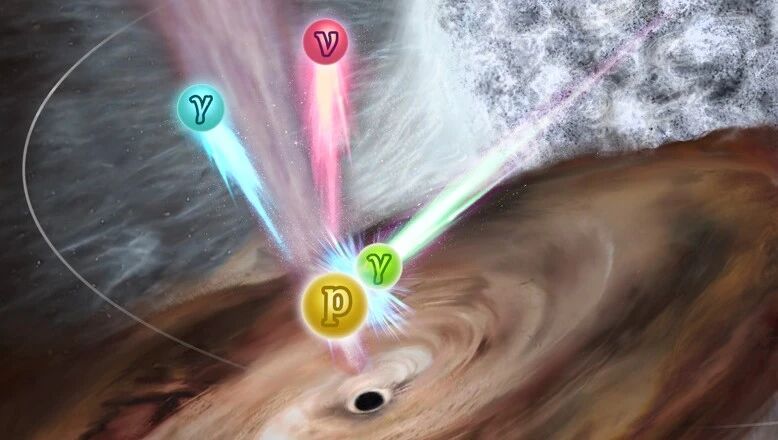
Schematic diagram of high-energy gamma photons and neutrinos produced by Cygnus X-3
By analyzing the variability and energy spectrum of ultra-high-energy gamma rays, LHAASO verified that Cygnus X-3 can accelerate cosmic-ray particles to at least 30 petaelectronvolts (PeV), making it the most powerful particle accelerator ever observed to date.
This finding opens a new avenue for investigating extreme physical processes near compact objects such as black holes. The relevant results were published online on July 22, 2026 in National Science Review, under the title “Cygnus X-3: A variable petaelectronvolt γ-ray source”. The corresponding authors include Prof. Cao Zhen, Associate Prof. Li Cong, Associate Prof. Wang Jieshuang, Associate Prof. Zhou Jianeng and Prof. Felix Aharonian.
This achievement has attracted tremendous attention within the astrophysics community and has become one of the most hotly discussed topics at international specialist conferences.
For this observational study, the muon detector array deployed in LHAASO’s core detection region and equipped with BHP’s 8-inch photomultiplier tubes (PMTs) played a critical role. Thanks to its outstanding dynamic range and superior reliability, the array captured the data leading to this landmark scientific discovery.
Moving forward, BHP will continue to advance core optoelectronic detection technologies and deliver high-performance detection solutions for domestic large scientific facilities, high-energy physics and other cutting-edge research fields.


Product: (86)-316-5970168/166/165
Other: (86)-10-63706370
E-mail: sctj@bhphoton.com


