



Supports
According to the different requirements of various application fields, users put forward new requirements for the types and performance indexes of scintillators constantly. The following will describe the specific types, performance index and the basic test methods briefly.
1. Classification of scintillators
The scintillation crystal we often talk about is a main type of scintillators. In addition, scintillation glass, scintillation ceramics, liquid scintillator, organic plastic scintillator, gas scintillator, etc., also belong to scintillators. As shown in Fig.1:
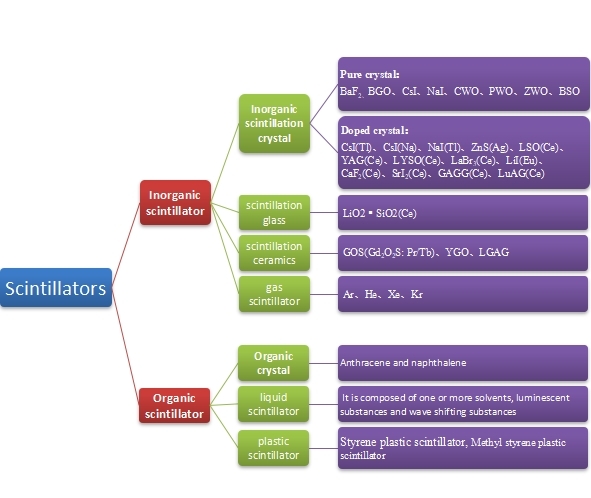
Fig. 1 Scintillator classification
2. Performance parameters of scintillator
2.1 Relative light output
Light output is defined as the ratio of the total photon number that scintillator emits to the incident radiation energy absorbed by scintillator. The relative light output refers to a relative value, comparing with the light output of the standard sample.
Light output is an important index to assess the scintillator energy conversion efficiency for high-energy particles. It is mainly related to the material. However, the value we obtained is technical light output actually, which relates to not only the thickness and shape of the scintillator, but also the reflective layer’s reflection efficiency, and the spectrum match between the detector and the scintillator and so on.
2.2 Energy resolution
Energy resolution is defined as, under a given energy, the ability to distinguish the minimum energy difference between the two particles. In general, the energy resolution is expressed by the ratio of FWHM (full width half maximum) to the peak, in the energy distribution curve of single energy particles. Its percentage data is known as pulse height resolution.
2.3 Decay time
The decay time is defined as, after a single excitation, the time from a photon emitted to 1/e of its initial value. Due to different luminescence mechanisms, the attenuation curve is sometimes divided into fast component and slow component. For example, BaF2 has two luminescent components with decay time of 0.9ns and 630ns respectively.
2.4 Afterglow
Afterglow is defined as the ratio of the scintillation light output at a certain time (such as 6ms, 20ms or 100ms) after excitation stops to the light output before excitation stops, because the scintillation will continue to emit photon for a period of time after the excitation stops. Fig.2 shows the afterglow curves with time of three scintillation materials. We can see that, the afterglows of GOS & CWO are similar, and both are significantly better than CsI(Tl).
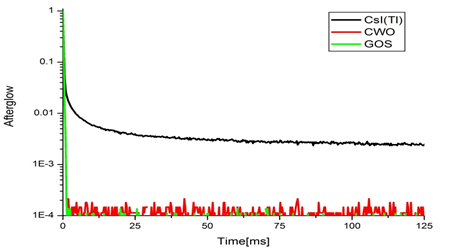
Fig. 2 afterglow curves of three scintillator materials
2.5 Environmental stability
In scintillator’s elements, the halide has obvious hygroscopicity, so some kinds of scintillator must be encapsulated in practical use. In addition, due to the anisotropy of thermal expansion coefficient of the material, the scintillator is prone to stress concentration or cracking after a certain temperature change. Other oxide scintillation crystals have obvious advantages in hygroscopicity resistance. Furthermore, under different environmental conditions, the performances of scintillators will change in varying degrees.
2.6 Irradiation resistance
After a large dose irradiation, the scintillation performance of scintillator will decline. This phenomenon is mainly related to the material structure, internal impurities or crystalline micro defects.
2. 7 Density
The material with high density has strong ability to absorb and prevent rays or particles, so high-energy detection can be achieved by using small thickness or volume. Therefore, general nuclear radiation detection fields hope to have a higher density scintillators.
In addition, the intrinsic characteristics of scintillators, such as emission spectrum, absorption spectrum, refractive index, technical light attenuation length and temperature effect, also have different influence on practical applications. It is necessary to select a suitable photodetector and environment.
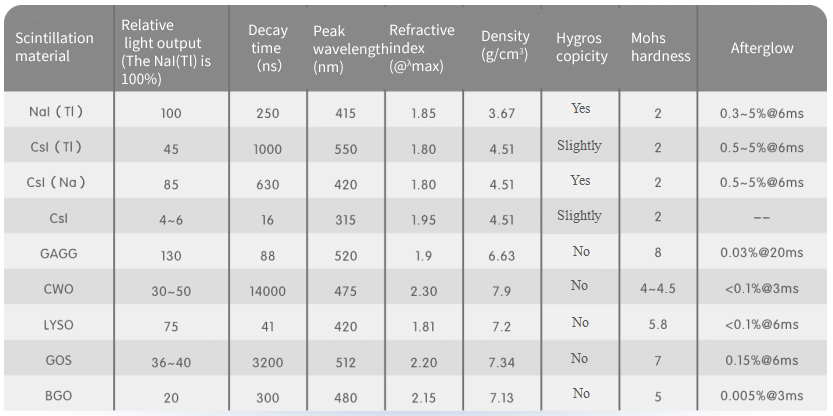
3. Material parameters of common inorganic scintillators
Table 1 Material parameters of common inorganic scintillators


Product: (86)-316-5970168/166/165
Other: (86)-10-63706370
E-mail: sctj@bhphoton.com